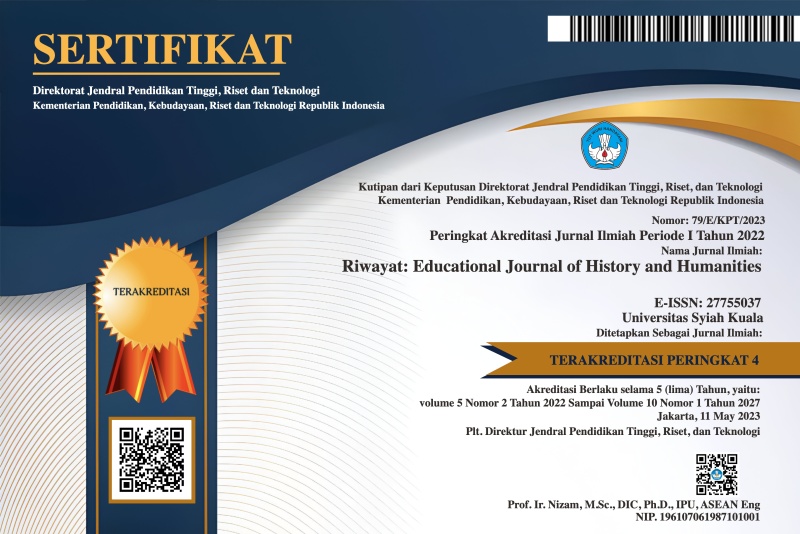
 Riwayat: Educational Journal of History and Humanities








Urgency of Stakeholders in Improving the Quality of Education
Abstract
Interactions between education providers and stakeholders who misperception and miscommunication have a negative impact on the quality of education. This paper aims to provide a complete and comprehensive discussion of the urgency of stakeholders in their roles, functions and understand their rights and obligations. The research method used in this paper is a qualitative method with a library research approach. The results of this study describe the urgency of stakeholders in terms of their role in providing information in the form of questions, inputs, suggestions and criticisms addressed to education providers, and stakeholders prioritizing ethical principles and functions when interacting with the school, as well as education providers updating the rules and formulas that are appropriate for the function and appropriate for the learning process. Formulas or learning formulas that integrate the interaction of the school with stakeholders must be applied massively. The interactions that are built lead to improving the quality of education. The conclusions of this paper lead to three aspects, first, the strategic role of stakeholders, Second, the rules and formulas for the interaction of education providers, and Third, the principles and functions of stakeholder interactions.
Full Text:
PDFReferences
Anggito, A., & Setiawan, J. (2018). Metodologi Penelitian Kualitatif. CV Jejak.
Annas, A. (2017). Interaksi Pengambilan Keputusan dan Evaluasi Kebijakan. Celebes Media Perkasa.
Azizurahman, A., & Santosa, S. (2022). Nilai-Nilai Pendidikan Islam dalam Tradisi Janengan serta Relevansinya dengan Karakter Nabi Muhammad. Intelektual: Jurnal Pendidikan Dan Studi Keislaman, 12(1), 52. https://doi.org/https://doi.org/10.33367/ji.v12i1.2342
Dewi, D. C., Jumaah, S. H., Utami, V. Y., Syahmat, M. Z., & Sarofah, R. (2022). Buku Ajar Kebijakan Publik. Wawasan Ilmu.
Gusman, B. A., Salsabila, U. H., Hoerotunnisa, Giardi, L. Y., & Fadhila, V. (2021). Efektifitas Paltform Wordwall pada Pembelajaran PAI di Madrasah Aliyah Negeri (MAN) pada Masa Pandemi. Intelektual: Jurnal Pendidikan Dan Studi Keislaman, 11(3), 205. https://doi.org/https://doi.org/10.33367/ji.v11i3.2080
Haramain, M. (2019). Prinsip-Prinsip Komunikasi dalam Alquran. IAIN Parepare Nusantara Press. https://doi.org/https://doi.org/10.21831/diksi.v15i2.6603
Hasibuan, N. S. (2022). Kebutuhan Peserta Didik. In Perkembangan Peserta Didik (p. 40). Pradina Pustaka.
Imzi, H. H. (2020). Prinsip-Prinsip Komunikasi dan Informasi dalam Perspektif Al-Qur’an: Membangun Komunikasi Beradab. Dakwah: Jurnal Kajian Dakwah Dan Kemasyarakatan, 24(1), 13. https://doi.org/https://doi.org/10.15408/dakwah.v24i1.17808
Izatin, D. N., & Susilo, S. (2022). Praktik Kepemimpinan Kepala Sekolah dalam Menyupervisi Pendidikan Agama Islam di Sekolah Menengah Pertama. Intelektual: Jurnal Pendidikan Dan Studi Keislaman, 12(1), 78. https://doi.org/https://doi.org/10.33367/ji.v12i1.2342
Jazeri, M. (2008). Realisasi Prinsip Kerjasama dalam Sebuah Interaksi. Jurnal Diksi: Fakultas Bahasa Dan Seni, 15(2), 150. https://doi.org/https://doi.org/10.21831/diksi.v15i2.6603
Muslim. (2020). Pengaruh Perhatian Orang Tua Terhadap Prestasi Belajar Anak dalam Mata Pelajaran Pendidikan Agama Islam. Deepublish.
Nefiana, D., Rahman, L. Z., & Sari, N. K. (2021). Peran Dewan Pendidikan terhadap Pembinaan dan Pengembangan Pendidikan Islam. Intelektual: Jurnal Pendidikan Dan Studi Keislaman, 11(3), 228. https://doi.org/https://doi.org/10.33367/ji.v11i3.1890
Rahmat, A. (2021). Hubungan Sekolah dan Masyarakat; Mengelola Partisipasi Masyarakat Dalam Peningkatan Mutu Sekolah. Zahir Publishing.
Riskiyono, D. (2022). Pengaruh Partisipasi dan Pengawasan Publik dalam Pembentukan Undang-Undang. Publica Indonesia Utama.
Rofiki, M., Zuhriyah, A., & Diana, E. (2022). Pengembangan Budaya Keagamaan Berbasis Kearifan Lokal dalam Meningkatkan Kinerja Guru di Sekolah Menengah Atas. Intelektual: Jurnal Pendidikan Dan Studi Keislaman, 12(1), 63. https://doi.org/https://doi.org/10.33367/ji.v12i1.2443
Rujiah, & Sa’diyah, M. (2021). Peran Stakeholder Pendidikan sebagai Penjamin Mutu Sekolah PAUD di TQK Baitul Izzah. Jurnal Rayah Al-Islam, 5(2), 639. https://doi.org/https://doi.org/10.21274/taalum.2018.6.2.347-371
Sulistyorini. (2018). Partisipasi Stakeholder Eksternal Dalam Meningkatkan Mutu Pendidikan di Sekolah Dasar. Ta’alum: Jurnal Pendidikan Islam, 6(2), 347. https://doi.org/https://doi.org/10.37274/rais.v5i02.490
Syukur, Y., Neviyarni, & Zahri, T. N. (2019). Bimbingan Konseling di Sekolah. CV IRDH.
Tobroni. (2018). Memperbincangkan Pemikiran Pendidikan Islam dari Idealisme Substantif hingga Konsep Aktual. Prenadamedia Group.
Wijoyo, H., Haryati, D., Indrawan, I., Mahdayeni, Marzuki, Rahmadhani, M. V., Desmaryani, S., Supriadi, Y. N., Sapiun, Z., & Amelya, D. (2021). Efektifitas Proses Pembelajaran di Masa Pandemi. Insan Cendekia Mandiri.
Yanti, N. L. T. (2021). Penerapan Akuntabilitas dan Transparansi Pengelolaan Dana Bos di SMP N 3 Sukawati dalam Program RKAS. Hita Akuntansi Dan Keuangan, 2(3), 143. https://doi.org/https://doi.org/10.32795/hak.v2i3.1805
Zed, M. (2008). Metode Penelitian Kepustakaan. Yayasan Obor Indonesia.
DOI: https://doi.org/10.24815/jr.v5i2.27600
Article Metrics
Abstract view : 0 timesPDF - 0 times
Refbacks
- There are currently no refbacks.

This work is licensed under a Creative Commons Attribution 4.0 International License.
Riwayat: Educational of History and Humanities indexed by
___________________________________________________________
Riwayat: Educational of History and Humanities
E-ISSN 2775-5037
P-ISSN 2614-3917
Published by History Education Department, Faculty of Teacher Training and Education, Universitas Syiah Kuala, Province Aceh. Indonesia
W :https://jurnal.usk.ac.id/riwayat
E : riwayat@usk.ac.id

This work is licensed under a Creative Commons Attribution-ShareAlike 4.0 International License.