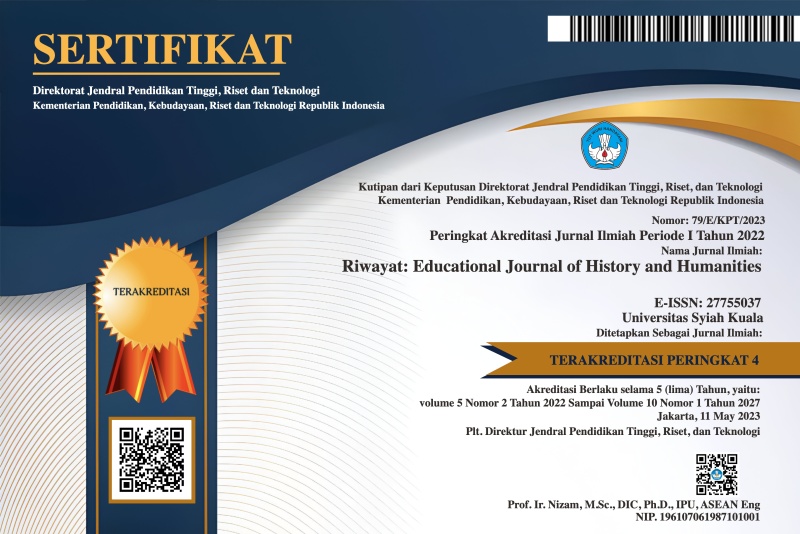
 Riwayat: Educational Journal of History and Humanities











Media Management of Gontor Television
Abstract
The development of the digital era is currently very intense, accompanied by the progress and rapid changes in the increasingly fast internet. According to the We Are Social report, the number of internet users in Indonesia has reached 213 million people as of January 2023. This number is equivalent to 77% of Indonesia's total population of 276.4 million people at the beginning of this year. The number of internet users in the country rose 5.44% compared to the previous year. This shift to fast internet has resulted in terrestrial television slowly starting to change into digital television. Looking at the data above, the increase in internet users is also caused by the millennial generation accessing all online-based content, namely social media which is currently viral. The aim of this research is to review how the big effect of social media can spread to the massive dissemination of information about the Pondok Modern Darussalam Gontor Islamic boarding school through Gontor television media management in terms of its system, structure and technical aspects. The method in this research uses descriptive qualitative with interview and observation data collection techniques. The research results show that Gontor television already has a strong and good crew foundation but is not yet professionally qualified. This also influences the operation of integrated systems and techniques between Gontor television centers and branches which have approximately 21 points throughout Indonesia.
Keywords
Full Text:
PDFReferences
Arikunto, S. (2010). Prosedur penelitian : suatu pendekatan praktik. Rineka Cipta.
Fachruddin, A. (2012). Dasar-dasar produksi televisi: Produksi Berita. Feature, Laporan Investigasi, Dokumenter, Dan Teknik Editing, Jakarta: Kencana.
Margono, S. (2003). Metodologi Penelitian Pendidikan Cet. 2. Jakarta: Rineka Cipta.
Moleong, L. J. (2007). Metodologi penelitian kualitatif edisi revisi.
NASUTION, D. R. S. (1996). Metode penelitian naturalistik kualitatif.
Permana, I. (2022, July 15). Adaptasi Digital Generasi X dalam Proses Omnichannel . Kompas.Com.
Sendari, A. A. (2021, February 14). Pengertian Sistem Menurut Para Ahli, Karakteristik dan Macamnya. Liputan6.
Setyobudi, C. (2006). Teknologi broadcasting TV. Jakarta: Graha Ilmu.
Sobry, M., & Prosmala Hadisaputra, M. P. (2020). Penelitian kualitatif Penelitian kualitatif. Bandung: PT. Remaja Rosda Karya.
Subroto, D. S. (1994). Produksi Acara Televisi. Yogyakarta: Duta Wacana University Press.
Sudjarwo. (2001). Metodologi penelitian sosial. Mandar Maju .
Sugiyono, D. (2013). Metode penelitian pendidikan pendekatan kuantitatif, kualitatif dan R&D.
DOI: https://doi.org/10.24815/jr.v7i3.40534
Article Metrics
Abstract view : 0 timesPDF - 0 times
Refbacks
- There are currently no refbacks.

This work is licensed under a Creative Commons Attribution 4.0 International License.
Riwayat: Educational of History and Humanities indexed by
___________________________________________________________
Riwayat: Educational of History and Humanities
E-ISSN 2775-5037
P-ISSN 2614-3917
Published by History Education Department, Faculty of Teacher Training and Education, Universitas Syiah Kuala, Province Aceh. Indonesia
W :https://jurnal.usk.ac.id/riwayat
E : riwayat@usk.ac.id

This work is licensed under a Creative Commons Attribution-ShareAlike 4.0 International License.