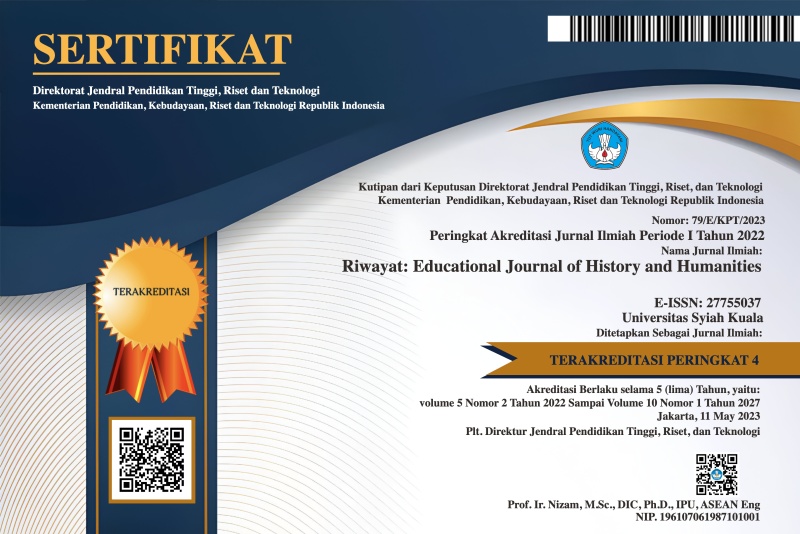
 Riwayat: Educational Journal of History and Humanities











Opportunities and Challenges: Revitalising the Accounting Profession Against Artificial Intelligent
Abstract
Technological developments noting Artificial Intelligence have impacted many aspects of activities and sectors of society, including the accounting profession. Therefore, this research is intended to analyse the opportunities and challenges that the AI revolution has on the accounting profession, as well as formulate a strategy to revitalise the role of accountants in the digital era. In this research, a qualitative approach method was used through literature review techniques. Based on the research results, it was found that AI offers enormous opportunities in improving efficiency, accuracy, and productivity through the automation of routine tasks such as transaction recording, data analysis, and so on. However, a significant source of risk has also emerged at the same time, and is a concern for the accounting profession today and in the future. Harnessing Artificial Intelligence impacts the liquidation process and the generation of new jobs, requiring the accounting profession to continuously evolve through challenges that demand increased technical, strategic competence and a deep understanding of technology. accounting as a strategic partner in business decision making. This article recommends collaborative efforts between educational institutions, professional organisations, and companies. As well as the development of accounting professional resources that are aligned with current conditions, to prepare accountants for the changes brought by Aritficial Intelligence. With the right approach, Artificial Intelligence will not only be a challenge, but also an opportunity to strengthen the relevance and sustainability of the accounting profession in the future.
Keywords
Full Text:
PDFReferences
Abdullah, A. A. H., & Almaqtari, F. A. (2024). The impact of artificial intelligence and Industry 4.0 on transforming accounting and auditing practices. Journal of Open Innovation: Technology, Market, and Complexity, 10(1), 100218.
Adelakun, B. O., Majekodunmi, T. G., & Akintoye, O. S. (2024). AI and ethical accounting: Navigating challenges and opportunities. International Journal of Advanced Economics, 6(6), 224–241.
Adeyelu, O. O., Ugochukwu, C. E., & Shonibare, M. A. (2024). The impact of artificial intelligence on accounting practices: advancements, challenges, and opportunities. International Journal of Management & Entrepreneurship Research, 6(4), 1200–1210.
Ahmad, A. Y. A. B. (2024). The Changing Role of Accountants in the AI Era: Evolving Skill Sets and Career Pathways. 2024 International Conference on Knowledge Engineering and Communication Systems (ICKECS), 1, 1–5.
Amelia, I., Azzahra, Y. N., Abda, A., & Azmi, Z. (2024). Pemanfaatan Artificial Intelligence Dalam Akuntansi: Kajian Literatur Review. Akuntansi, 3(1), 129–140.
Ayinla, B. S., Atadoga, A., Ike, C. U., Ndubuisi, N. L., Asuzu, O. F., & Adeleye, R. A. (2024). The Role Of Robotic Process Automation (Rpa) In Modern Accounting: A Review-Investigating How Automation Tools Are Transforming Traditional Accounting Practices. Engineering Science & Technology Journal, 5(2), 427–447.
Coman, D. M., Ionescu, C. A., Duică, A., Coman, M. D., Uzlau, M. C., Stanescu, S. G., & State, V. (2022). Digitization of accounting: The premise of the paradigm shift of role of the professional accountant. Applied Sciences, 12(7), 3359.
Cordos, A., & Tiron-Tudor, A. (2023). EMPLOYABILITY SKILLS FOR PROFESSIONAL ACCOUNTANTS IN THE MIDST OF INDUSTRY 4.0–A LITERATURE REVIEW. Journal of Financial Studies, 8(15), 62–85.
Ducato, R. (2020). Data protection, scientific research, and the role of information. Computer Law & Security Review, 37, 105412.
Gotthardt, M., Koivulaakso, D., Paksoy, O., Saramo, C., Martikainen, M., & Lehner, O. (2020). Current state and challenges in the implementation of smart robotic process automation in accounting and auditing. ACRN Journal of Finance and Risk Perspectives.
Hernawati, N., Maemunah, M., & Kuntorini, R. S. (2021). Analisis Hardskill Mahasiswa Akuntansi Terhadap Kompetensi Auditor Era Revolusi Industri 4.0. Kajian Akuntansi, 22(1), 109–117.
Jianwu, L. W., Yew, L. S., On, L. K., Keong, T. C., Yuan Sheng, R. T., Sani, S. Bin, & Juan Agnes, T. H. (2024). Artificial intelligence-enabled evaluating for computer-aided drawings (AMCAD). International Journal of Mechanical Engineering Education, 52(1), 3–31.
Khasanah, A., Aini, M., & Aji, G. (2024). Menuju Masa Depan Akuntansi: Akuntansi di Era Big Data dan Kecerdasan Buatan. Jurnal Ilmiah Ekonomi, Manajemen, Bisnis Dan Akuntansi, 1(2), 312–318.
Li, H. (2020). Research and analysis on sensitive data encryption method in accounting information processing system. International Journal of Internet Manufacturing and Services, 7(1–2), 146–161.
Lindsay, H. (2020). From fledgling to fledged: how accountants in academia develop their research capabilities. Accounting Education, 29(4), 409–430.
Ng, C. (2023). Teaching advanced data analytics, robotic process automation, and artificial intelligence in a graduate accounting program. Journal of Emerging Technologies in Accounting, 20(1), 223–243.
Oviya, S., Sharadha, N., Bhuvaneswari, E., Vijayalakshmi, S., & Sushma, K. (2024). The Impact of Automation and Ai in Revolutionising Traditional Accounting Methods. Journal of Informatics Education and Research, 4(2).
Remlein, M., Bejger, P., Olejnik, I., Jastrzębowski, A., & Obrzeżgiewicz, D. (2022). The application of Robotic Process Automation in the financial accounting in entities that operate in Poland. The Theoretical Journal of Accounting, 46(1), 47–65.
Sumadi, M. I. T. B. N., Putra, R., & Firmansyah, A. (2022). Peran perkembangan teknologi pada profesi akuntan dalam menghadapi industri 4.0 dan society 5.0. Journal of Law, Administration, and Social Science, 2(1), 56–68.
Supriadi, I. (2024). The audit revolution: Integrating artificial intelligence in detecting accounting fraud. Akuntansi Dan Teknologi Informasi, 17(1), 48–61.
Zheng, M. (2022). Advanced artificial intelligence model for financial accounting transformation based on machine learning and enterprise unstructured text data. Mobile Information Systems, 2022(1), 5708652.
DOI: https://doi.org/10.24815/jr.v8i1.43906
Article Metrics
Abstract view : 0 timesPDF - 0 times
Refbacks
- There are currently no refbacks.

This work is licensed under a Creative Commons Attribution 4.0 International License.
Riwayat: Educational of History and Humanities indexed by
___________________________________________________________
Riwayat: Educational of History and Humanities
E-ISSN 2775-5037
P-ISSN 2614-3917
Published by History Education Department, Faculty of Teacher Training and Education, Universitas Syiah Kuala, Province Aceh. Indonesia
W :https://jurnal.usk.ac.id/riwayat
E : riwayat@usk.ac.id

This work is licensed under a Creative Commons Attribution-ShareAlike 4.0 International License.