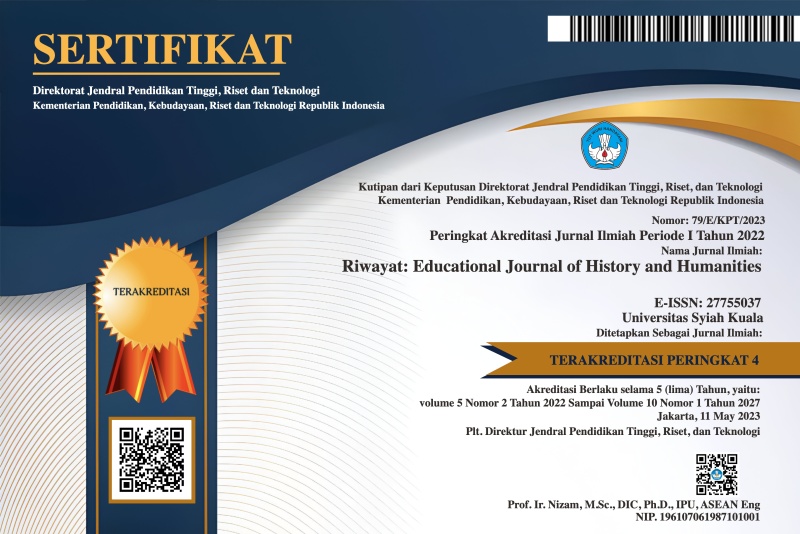
 Riwayat: Educational Journal of History and Humanities











Ethical Considerations in Algorithmic Decision-making: Towards Fair and Transparent AI Systems
Abstract
Artificial intelligence (AI)-based algorithmic decision-making is a major concern in the digital age due to its potential to improve efficiency in various sectors, including healthcare, law, and finance. However, its implementation poses significant ethical challenges, such as bias in data and a lack of transparency that can affect fairness and public trust. This research aims to explore ethical considerations in algorithmic decision-making with a focus on fairness and transparency, identify key challenges, and provide policy recommendations to improve the accountability of AI systems. The research method uses a qualitative approach through literature studies that include academic articles, books, and research reports. The results show that algorithmic bias often arises due to unrepresentative historical data, while low transparency makes it difficult to understand the decision-making process. To overcome this problem, independent algorithm audits, the application of explainable AI, progressive regulations, public education, and the use of more diverse data are needed. This recommendation aims to create a fair, transparent, and trustworthy AI system, thereby supporting wider acceptance of the technology in society.
Keywords
Full Text:
PDFReferences
Balenović, K., & Proroković, J. (n.d.). The Usage of AI Tools in Lexical-Semantic Analysis of Anglicisms in the Croatian Language. 38. Međunarodni Znanstveni Skup HDPL-a" Jezik u Doba Globalizacije".
Blake, H. (2024a). AI in Criminal Justice: Addressing Concerns About Bias, Fairness, and Accountability in Predictive Policing and Sentencing Algorithms.
Blake, H. (2024b). AI in Healthcare: Ethical Considerations in the Use of AI for Diagnosis, Treatment, and Patient Data Management.
Bowen, G. A. (2009). Document analysis as a qualitative research method. Qualitative Research Journal, 9(2), 27–40.
Charkra, S., Dey, S., John, A., & Kanti, S. (2024). The Human Factor in AI Decision-Making: Mitigating Bias and Error.
Dudek, A., Dąbek, A., Zborowska, I., & Lichosik, J. (2023). Integrating artificial intelligence in forensic science. E-Methodology, 10(10), 15–28.
Fauzan, R., Harsono, K., Meisandy, R. P., Barokah, M., & Muhaimin, M. I. (2024). Optimising Human Resource Management as an Effort to Improve Employee Performance through Digital Attendance. Riwayat: Educational Journal of History and Humanities, 7(1), 16-25.
Gorantla, B., & Devineni, S. (2024). Evaluation of Explainable Artificial Intelligence using TOPSIS Method. Computer Science, Engineering and Technology, 2(2).
Herke, H. C., & Szabó, B. (2024). Self-Driving Vehicles and Their Impact on the European Convention on Human Rights. Journal of Human Rights, Culture and Legal System, 4(3), 872–900.
Kalishina, D. (2023). Artificial Intelligence As An Enabler Of Growth: Advancing Business Analytics In Small And Medium Enterprises. International Journal of Core Engineering & Management, 7(5), 289–300.
Khan, M. (2025a). A Framework for Automated Insights: Exploring AI-Driven Data Science Techniques. Intelligent Data Science and Analytics, 1(01), 10–22.
Khan, M. (2025b). Systematic Review on Advancing Decision-Making: Integrating Intelligent Data Science and Predictive Analytics for Real-World Applications. Intelligent Data Science and Analytics, 1(01), 1–9.
Maathuis, C. (2024). Insights into Building VR Solutions in the Police Domain. Proceedings of the International Conference on Education Research.
Patil, K. R. (2025). ALGORITHMIC DECISION-MAKING IN HR: NAVIGATING FAIRNESS, TRANSPARENCY, AND GOVERNANCE IN THE AGE OF AI. Journal of Computer Engineering and Technology (IJCET), 16(1), 359–367.
Paz-Peñuelas-Oliván, J., & Ruz, J. (2025). Machine-learning methods for blind characterisation of nuclear fuel assemblies. Nuclear Engineering and Technology, 103462.
Ridley, D. (2012). The literature review: A step-by-step guide for students.
Roseth, T. (2024). Ethical Implications and Solutions for AI-Driven Machine Learning in Business Intelligence.
Setiawati, I., Wardani, S., & Lestari, W. (2024). Development of Wordwall-based Indonesian Geographical Condition Assessment Instrument in Modipaskogo E-Book for Elementary School Students. Riwayat: Educational Journal of History and Humanities, 7(1), 48-65.
Snyder, H. (2019). Literature review as a research methodology: An overview and guidelines. Journal of Business Research, 104, 333–339.
Unalp, A. (2024). AI-Driven Predictive Analytics: Shaping the Future of Strategic Decision Making.
Wulandari, D. (2024). The Effectiveness of Youtube Channel as Learning Media at Conversation Class. Riwayat: Educational Journal of History and Humanities, 7(1), 67-69.
Zafer, M., & Sani, M. (2024). Trustworthy Artificial Intelligence: Fine-Tuning Machine Learning Models with Ethics and Safety.
Zahra, Y. (2025). Regulating AI in Legal Practice: Challenges and Opportunities. Journal of Computer Science Application and Engineering (JOSAPEN), 3(1), 10–15.
DOI: https://doi.org/10.24815/jr.v8i1.44112
Article Metrics
Abstract view : 0 timesPDF - 0 times
Refbacks
- There are currently no refbacks.

This work is licensed under a Creative Commons Attribution 4.0 International License.
Riwayat: Educational of History and Humanities indexed by
___________________________________________________________
Riwayat: Educational of History and Humanities
E-ISSN 2775-5037
P-ISSN 2614-3917
Published by History Education Department, Faculty of Teacher Training and Education, Universitas Syiah Kuala, Province Aceh. Indonesia
W :https://jurnal.usk.ac.id/riwayat
E : riwayat@usk.ac.id

This work is licensed under a Creative Commons Attribution-ShareAlike 4.0 International License.