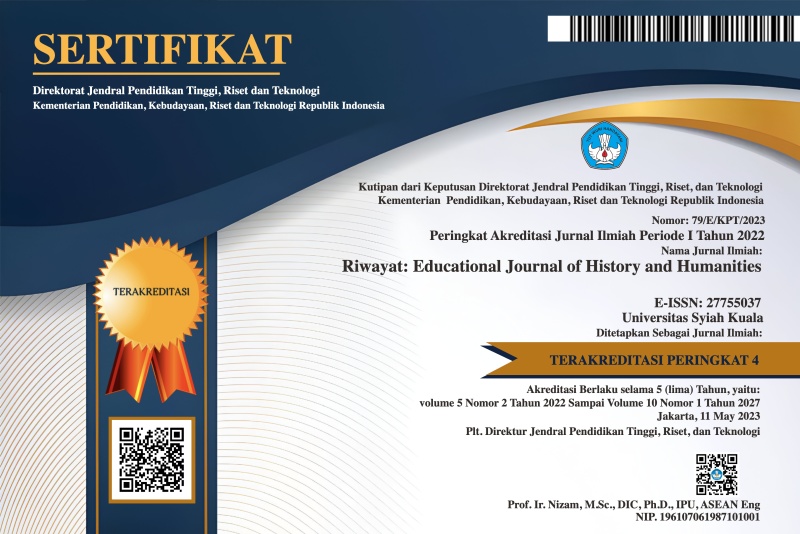
 Riwayat: Educational Journal of History and Humanities











Human Development Strategy Welcomes the Peak of the Demographic Bonus in Indonesia
Abstract
This study aims to elaborate the human development strategy towards the peak of demographic bonuses in Indonesia. The specific objectives of this study were to analyze (1) the number and population growth in Denpasar City, Bali Province; and (2) employment opportunities and challenges in Denpasar City, Bali Province.This study fully uses secondary data collected from various publications. The data analysis was descriptive where the relationships between variables are carried out with a descriptive approach. The study result indicates that bonus demographics will occur in the range of 2015-2025 inthe Denpasar City, because population growth continues to increase and the share of the productive age population is also more dominant than the non-productive population. However, the level of preparation in the labor sector has so far not been optimal. These conditions threaten Denpasar City can not reach the benefits of this window of opportunity.This is due to still unemployment in the Denpasar City.
Keywords
Full Text:
PDFReferences
Anwar, M. S. (2015). Menyongsong Bonus Demogrfi Studi Kependudukan Dan Lingkungan Hidup. Jurnal Manajemen dan Strategi Bisnis. Vol. 12, No. 2, 62-71
Astuti, H.W. & Soetarmiyati, N. (2016). Mengukur Peluang dan Ancaman Bonus Demografi terhadap Kualitas Sumberdaya Manusia dalam Pembangunan Ekonomi di Bandar Lampung. Jurnal Bisnis Darmajaya. Vol. 2, No. 01, 57-76.
Badan Pusat Statistik Kota Denpasar. (2018). Kota Denpasar Dalam Angka 2018. BPS Kota Denpasar.
Badan Pusat Statistik. (2018) Proyeksi Penduduk Kabupaten/Kota Provinsi Bali 2018-2023. Badan Pusat Statistik, Jakarta.
Bloom, D.E., Canning, D. & Sevilla, J. (2012). The Demographic Dividend: A New Perspective on the Economic Consequences of Population Change. A RAND Program of Policy-Relevant Research Communication, Pittsburgh, USA.
Heryanah. (2018). Ageing Population Dan Bonus Demografi Kedua Di Indonesia. Populasi. Vol. 23, No. 2, 1-16.
Imran, M. F. (2024). Criminological Examination of Physical and Psychological Violence Committed Against Children in the School Environment. Riwayat: Educational Journal of History and Humanities, 7(1), 41-47.
Madjid, R. (2016). Kualitas Sumber Daya Manusia dalam Menggapai Bonus Demografi. Jurnal Performa, Vol. 3, No. 4, 480-495.
Mankiw, N.G. (2010). Principles of Economics. International Edition, 6th Edition, South-Western Cengage Learning, Canada.
Romulo, C. S., & Dalimunthe, Z. (2024). Effect of related party transaction and tax haven utilization on tax avoidance moderated by Country-by-Country reporting. Riwayat: Educational Journal of History and Humanities, 7(1), 26-40.
Setiawati, I., Wardani, S., & Lestari, W. (2024). Development of Wordwall-based Indonesian Geographical Condition Assessment Instrument in Modipaskogo E-Book for Elementary School Students. Riwayat: Educational Journal of History and Humanities, 7(1), 48-65.
Todaro, M.P. & S.C. Smith. (2011). Pembangunan Ekonomi. Edisi Kesembilan Jilid 1 , Erlangga, Jakarta.
DOI: https://doi.org/10.24815/jr.v8i2.44839
Article Metrics
Abstract view : 0 timesPDF - 0 times
Refbacks
- There are currently no refbacks.

This work is licensed under a Creative Commons Attribution 4.0 International License.
Riwayat: Educational of History and Humanities indexed by
___________________________________________________________
Riwayat: Educational of History and Humanities
E-ISSN 2775-5037
P-ISSN 2614-3917
Published by History Education Department, Faculty of Teacher Training and Education, Universitas Syiah Kuala, Province Aceh. Indonesia
W :https://jurnal.usk.ac.id/riwayat
E : riwayat@usk.ac.id

This work is licensed under a Creative Commons Attribution-ShareAlike 4.0 International License.