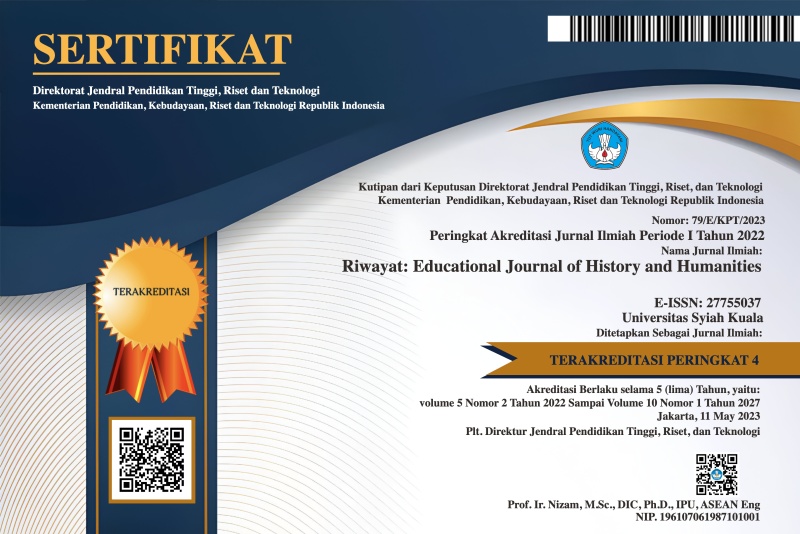
 Riwayat: Educational Journal of History and Humanities











Disaster Communication in Local Governments Karangasem Regency, Bali Indonesia to Realize Sustainable Tourism
Abstract
The results of the study show that disaster communication in Karangasem Regency Bali is carried out by BPBD Karangasem in collaboration with the community and tourism managers to convey disaster information to the community and tourists. However, it is necessary to improve coordination between the Tourism Office and BPBD and increase tourists' understanding of disaster risks to support the realization of sustainable tourism.
Keywords
Full Text:
PDFReferences
Aliperti, G., Nagai, H., & Cruz, A. M. (2020). Communicating risk to tourists: A mental models approach to identifying gaps and misperceptions. Tourism Management Perspectives, 33(March 2019), 100615. https://doi.org/10.1016/j.tmp.2019.100615
Azis, A., & Kusnafizal, T. (2024). Information and Communication Technology in the Learning Process. JTP-Jurnal Teknologi Pendidikan, 26(1), 158-170.
Bergeron, C. D., & Friedman, D. B. (2015). Developing an evaluation tool for disaster risk messages. Disaster Prevention and Management, 24(5), 570–582. https://doi.org/10.1108/DPM-11-2014-0224
Budi HH, S. (2012). Komunikasi Bencana: Aspek Sistem (Koordinasi, Informasi dan Kerjasama). Jurnal ASPIKOM, 1(4), 362. https://doi.org/10.24329/aspikom.v1i4.36
Budiatiningsih, M., Rosyidie, A. (2022). Profil Sadar Bencana Pengunjung Kawasan Wisata Rawan Bencana Gunung Merapi Di Kabupaten Sleman, Diy. Jumpa, 9(1), 287-308
Chan, C. S., Nozu, K., & Zhou, Q. (2020). Tourism stakeholder perspective for disaster-management process and resilience: The case of the 2018 Hokkaido Eastern Iburi Earthquake in Japan. Sustainability (Switzerland), 12(19). https://doi.org/10.3390/SU12197882
Cui, F., Liu, Y., Chang, Y., Duan, J., & Li, J. (2016). An overview of tourism risk perception. Natural Hazards, 82(1), 643–658. https://doi.org/10.1007/s11069-016-2208-1
Ghaderi, Z., Mat Som, A. P., & Henderson, J. C. (2015). When Disaster Strikes: The Thai Floods of 2011 and Tourism Industry Response and Resilience. Asia Pacific Journal of Tourism Research, 20(4), 399–415. https://doi.org/10.1080/10941665.2014.889726
Gultom, D. I. (2016). Community-based disaster communication: how does it become trustworthy? Disaster Prevention and Management, 25(4), 478–491. https://doi.org/10.1108/DPM-02-2016-0026
Hassan Ananzeh, M. M., Ismail, A. I., & Awawdeh, A. (2021). Client perceptions of Emirati innovation strategy on service quality in UAE tourism sector. Rural Society, 30(2–3), 119–128. https://doi.org/10.1080/10371656.2021.1988348
Ikhsan, J. (2010). Study on Integrated Sediment Management in an Active Volcanic Basin. 京都大学 (Kyoto University).
Le Roux, T., & Van Niekerk, D. (2020). Challenges in stakeholders self-organising to enhance disaster communication. Corporate Communications, 25(1), 128–142. https://doi.org/10.1108/CCIJ-07-2019-0078
Lestari, P., Kusumayudha, S. B., Paripurno, E. T., & Ramadhaniyanto, B. (2016). Komunikasi Lingkungan untuk Mitigasi Bencana Erupsi Gunung Sinabung. Jurnal ASPIKOM, 3(1), 56. https://doi.org/10.24329/aspikom.v3i1.98
Lestari, P., Ritonga, R., Ruliana, P., & Barus, C. C. B. (2020). Disaster communication uses field training exercise simulation as an important aspect of disaster risk reduction. Jurnal Komunikasi: Malaysian Journal of Communication, 36(1), 166–186. https://doi.org/10.17576/JKMJC-2020-3601-10
Lin, K. H. E., Khan, S., Acosta, L. A., Alaniz, R., & Olanya, D. R. (2020). The dynamism of post disaster risk communication: A cross-country synthesis. International Journal of Disaster Risk Reduction, 48(March), 101556. https://doi.org/10.1016/j.ijdrr.2020.101556
Liu, B. F., & Mehta, A. M. (2021). From the periphery and toward a centralized model for trust in government risk and disaster communication. Journal of Risk Research, 24(7), 853–869. https://doi.org/10.1080/13669877.2020.1773516
Liu, Y., Cheng, P., & OuYang, Z. (2019). Disaster risk, risk management, and tourism competitiveness: A cross-nation analysis. International Journal of Tourism Research, 21(6), 855–867. https://doi.org/10.1002/jtr.2310
Lo, A. S., Cheung, C., & Law, R. (2011). Hong kong residents’ adoption of risk reduction strategies in leisure travel. Journal of Travel and Tourism Marketing, 28(3), 240–260. https://doi.org/10.1080/10548408.2011.562851
Mair, J., Ritchie, B. W., & Walters, G. (2016). Towards a research agenda for post-disaster and post-crisis recovery strategies for tourist destinations: a narrative review. Current Issues in Tourism, 19(1), 1–26. https://doi.org/10.1080/13683500.2014.932758
Mehta, A. M., Bruns, A., & Newton, J. (2017). Trust, but verify: social media models for disaster management. Disasters, 41(3), 549–565. https://doi.org/10.1111/disa.12218
Moorthy, R., Benny, G., & Gill, S. S. (2018). Disaster communication in managing vulnerabilities. Jurnal Komunikasi: Malaysian Journal of Communication, 34(2), 51–66. https://doi.org/10.17576/JKMJC-2018-3402-04
Nagai, H., Saito, H., Aliperti, G., & W. Ritchie, B. (2023). Tourism Disaster Risk Communication: Foreign Employees’ Preparedness and Involvement in the Japanese Accommodation Industry. Tourism Planning and Development, 20(3), 489–498. https://doi.org/10.1080/21568316.2021.2001038
Nurjanah, Adhianty. (2022). Cooperation in Disaster Communication Model in Bali, Indonesia. International Journal of Sustainable Development and Planning, 17(5), 1561-1569
Nurjanah, Adhianty. (2023). ICT-Based Lombok Disaster Management Communication Model in Indonesian. Journal Sociologia y tecnoniencia, 13(2), 137-149
Nurjanah, A., Ikhsan, J., & Rasyid, E. (2023). Komunikasi Bencana Menuju Pariwisata Berkelanjutan di Indonesia. PT RajaGrafindo Persada.
Pizam, A., Jeong, G.-H., Reichel, A., van Boemmel, H., Lusson, J. M., Steynberg, L., State-Costache, O., Volo, S., Kroesbacher, C., & Kucerova, J. (2004). The relationship between risk-taking, sensation-seeking, and the tourist behavior of young adults: A cross-cultural study. Journal of Travel Research, 42(3), 251–260.
Purworini, D., Hartuti, D. P., & Purnamasari, D. (2021). Why is evacuation so difficult? Sociocultural aspects of landslide disaster in Ponorogo, Indonesia. Disaster Prevention and Management: An International Journal, 30(2), 137–148. https://doi.org/10.1108/DPM-04-2019-0123
Ritchie, B. W. (2008). Tourism disaster planning and management: From response and recovery to reduction and readiness. Current Issues in Tourism. https://doi.org/10.1080/13683500802140372
Rochim, M., Bajari, A., Damayani, N. A., & Bakti, I. (2020). Community-based disaster communication management. Jurnal Komunikasi: Malaysian Journal of Communication, 36(4), 339–350. https://doi.org/10.17576/JKMJC-2020-3604-21
Seeger, M. W., & Sellnow, T. L. (2019). Communication in times of trouble. John Wiley & Sons.
Setiawati, I., Wardani, S., & Lestari, W. (2024). Development of Wordwall-based Indonesian Geographical Condition Assessment Instrument in Modipaskogo E-Book for Elementary School Students. Riwayat: Educational Journal of History and Humanities, 7(1), 48-65.
Sugiyono. (2013). Metode Penelitian Pendidikan Pendekatan Kuantitatif, Kualitatif, dan R&D. Alfabeta
Tang, R. (2022). A study of the effects and mechanisms of the digital economy on high-quality tourism development: evidence from the Yangtze River Delta in China. Asia Pacific Journal of Tourism Research, 27(11), 1217–1232. https://doi.org/10.1080/10941665.2023.2174033
Wardyaningrum, D. (2014). Perubahan Komunikasi Masyarakat Dalam Inovasi Mitigasi Bencana di Wilayah Rawan Bencana Gunung Merapi. Jurnal ASPIKOM, 2(3), 179. https://doi.org/10.24329/aspikom.v2i3.69
Williams, A. M., & Baláž, V. (2013). Tourism, risk tolerance and competences: Travel organization and tourism hazards. Tourism Management, 35, 209–221. https://doi.org/10.1016/j.tourman.2012.07.006
Wulandari, D. (2024). The Effectiveness of Youtube Channel as Learning Media at Conversation Class. Riwayat: Educational Journal of History and Humanities, 7(1), 67-69.
Wulan, T. R., Ambarwulan, W., Wahyuningsih, D. S., Maulana, E., Raharjo, T., Ibrahim, F., Putra, M. D., Setyaningsih, Z., & Megawati, E. I. (2016). Mitigasi Bencana Berbasis Potensi Wisata : Studi Kasus Pantai Pandawa , Desa Kutuh , Kecamatan Kutu Selatan , Kabupaten Badung ,. Prosiding Seminar Nasional Kelautan 2016, Juli, 261–266. https://www.researchgate.net/publication/309555791
Yudarwati, G. A., Putranto, I. A., & Delmo, K. M. (2022). Examining the Indonesian government’s social media use for disaster risk communication. Asian Journal of Communication, 32(1), 1–20. https://doi.org/10.1080/01292986.2021.2007274.
DOI: https://doi.org/10.24815/jr.v8i2.45506
Article Metrics
Abstract view : 0 timesPDF - 0 times
Refbacks
- There are currently no refbacks.

This work is licensed under a Creative Commons Attribution 4.0 International License.
Riwayat: Educational of History and Humanities indexed by
___________________________________________________________
Riwayat: Educational of History and Humanities
E-ISSN 2775-5037
P-ISSN 2614-3917
Published by History Education Department, Faculty of Teacher Training and Education, Universitas Syiah Kuala, Province Aceh. Indonesia
W :https://jurnal.usk.ac.id/riwayat
E : riwayat@usk.ac.id

This work is licensed under a Creative Commons Attribution-ShareAlike 4.0 International License.