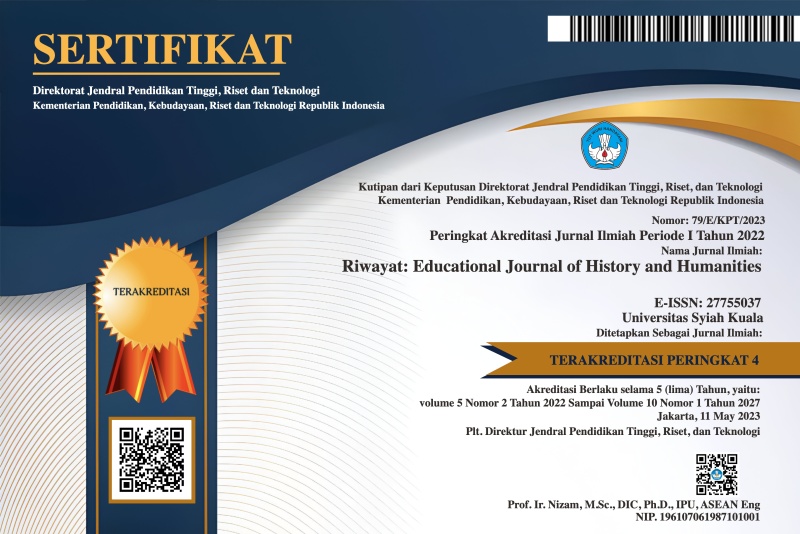
 Riwayat: Educational Journal of History and Humanities











Strategy for Winning Legislative Members of the House of Representatives in the 2024 Elections: A Case Study of Winning Legislative Members in Constituency I of Aimas District, Sorong Regency, West Papua Province
Abstract
the contest and political struggle for a political position, strategy plays a decisive role. This research aims to 1) identify the winning strategies of legislative members. 2) determine the differences in winning strategies between incumbents and newcomers. 3) analyze the factors that contribute to winning and successfully qualifying in Electoral District I of Aimas District to become a member of the Sorong Regency Regional Representative Council in the province of South West Papua. Without a solid strategic plan, victory may not be achieved. Political strategy is essential and must be possessed by every participant in the political contest in order to win the election. The research uses a descriptive qualitative method, examining the strategies played by both incumbent legislative members (those re-elected) and new candidates. The incumbent candidate supported by the Indonesian Democratic Party of Struggle (PDI-P) is Nurtina Lakasa, and the incumbent candidate Tarmuji, supported by the National Mandate Party (PAN), so that they can be elected again as legislative members. Similarly, the strategy used by the new entrants, namely Markus Matana supported by the Golkar Party and Lukas Hermawan supported by the National Awakening Party (PKB), successfully passed the election in Electoral District I Aimas to become members of the Regional House of Representatives of Sorong Regency, West Papua Province in the 2024 elections. This political strategy will be examined using the approach proposed by Peter Shroder (2004) regarding strategic planning. The research findings that 1) There are several winning strategies implemented by both incumbents and newcomers, namely organizational strategies, including preparing all the necessities for victory through the formation of success teams, setting campaign targets, choosing campaign messages, and selecting media in each electoral district to support all activities. (2) There are significant differences in winning strategies between incumbent candidates and newcomers. 3) Both incumbent candidates and newcomers engage in personal branding in an effort to garner votes in the legislative elections in Electoral District I, Aimas District, Sorong Regency, Southwest Papua Province in the 2024 legislative elections. Researchers use the self-concept theory to analyze the personal branding of each candidate who successfully passed through observation of campaign props. The self-concept theory is related to personal branding because it explains the self-assessment that is psychological, social, and physical regarding appearance, behavior, feelings, attitudes, abilities, and resources possessed by the candidates. There are 5 external factors that are general and 3 internal factors that play a role in the personal branding of each candidate, both incumbent candidates and newcomers.
Full Text:
PDFDOI: https://doi.org/10.24815/jr.v8i4.48708
Article Metrics
Abstract view : 0 timesPDF - 0 times
Refbacks
- There are currently no refbacks.
Riwayat: Educational of History and Humanities indexed by
___________________________________________________________
Riwayat: Educational of History and Humanities
E-ISSN 2775-5037
P-ISSN 2614-3917
Published by History Education Department, Faculty of Teacher Training and Education, Universitas Syiah Kuala, Province Aceh. Indonesia
W :https://jurnal.usk.ac.id/riwayat
E : riwayat@usk.ac.id

This work is licensed under a Creative Commons Attribution-ShareAlike 4.0 International License.