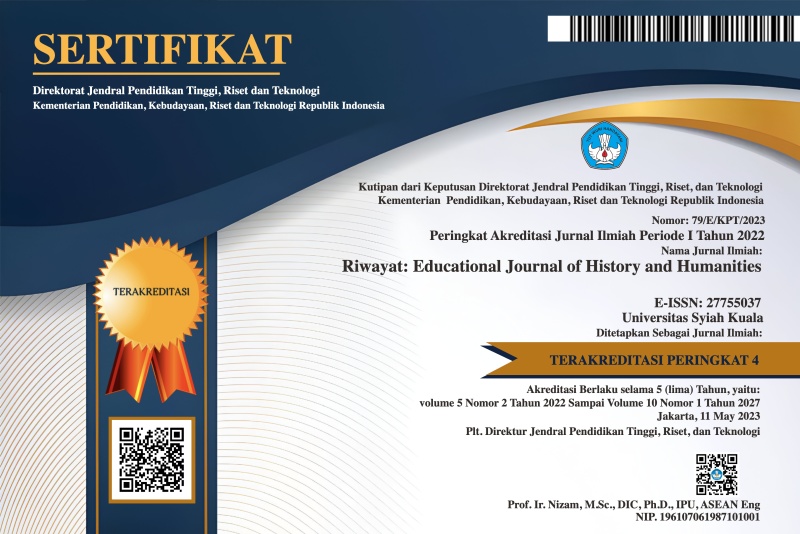
 Riwayat: Educational Journal of History and Humanities









Pengembangan Kemampuan Berpikir Kritis dalam Pendidikan Nonformal: Telaah Konseptual dan Strategi Pembelajaran Kontekstual
Abstract
Critical thinking skills are a key competency of the 21st century that needs to be developed not only in formal education but also in non-formal education. This study aims to examine the effectiveness of various innovative learning strategies in developing critical thinking skills and to evaluate their relevance in the context of non-formal education. Using a narrative literature review approach, twelve relevant scientific articles were analyzed thematically. The synthesis results show that approaches such as Teaching Case, Self-Organized Learning Environment (SOLE), blended learning, and the integration of technology and artificial intelligence (AI) are consistently able to improve critical thinking indicators, including interpretation, analysis, evaluation, and inference. These approaches are considered relevant and applicable in non-formal education because they are contextual, flexible, and support independent and collaborative learning. This study recommends strengthening the capacity of non-formal facilitators and adapting reflective and technology-based learning strategies to create a learning environment that supports the formation of critical and empowered learners.
Full Text:
PDFDOI: https://doi.org/10.24815/jr.v8i3.48947
Article Metrics
Abstract view : 0 timesPDF - 0 times
Refbacks
- There are currently no refbacks.
Riwayat: Educational of History and Humanities indexed by
___________________________________________________________
Riwayat: Educational of History and Humanities
E-ISSN 2775-5037
P-ISSN 2614-3917
Published by History Education Department, Faculty of Teacher Training and Education, Universitas Syiah Kuala, Province Aceh. Indonesia
W :https://jurnal.usk.ac.id/riwayat
E : riwayat@usk.ac.id

This work is licensed under a Creative Commons Attribution-ShareAlike 4.0 International License.