 Riwayat: Educational Journal of History and Humanities







Can A Presidents Statement be A Treaty Violation? A Case Study on Trumps Statement on 2% Defence Spending
Abstract
Donald Trump, The President of the United States, stated that his country would not defend any NATO members that do not spend 2% of their Gross Domestic Product to defense spending. His statement has raised concerns about the credibility of the collective defense mechanism outlined in Article 5 of the North Atlantic Treaty, signed in 1949. This article examines whether Trumps statement as a head of state would constitute an internationally wrongful act under the articles on the responsibility of states for internationally wrongful acts. Using juridical normative method, it analyses treaty text, legal doctrine, and state practice. The study found that Article 5 of the NATO Treaty is flexible and allows each member to decide how to respond to an attack against other members. Thus, Trumps statement alone cannot be classified as a breach of international law unless it is accompanied by specific acts of refusal of support towards NATO Members.
Full Text:
PDFDOI: https://doi.org/10.24815/jr.v8i4.50051
Article Metrics
Abstract view : 0 timesPDF - 0 times
Refbacks
- There are currently no refbacks.
Riwayat: Educational of History and Humanities indexed by
___________________________________________________________
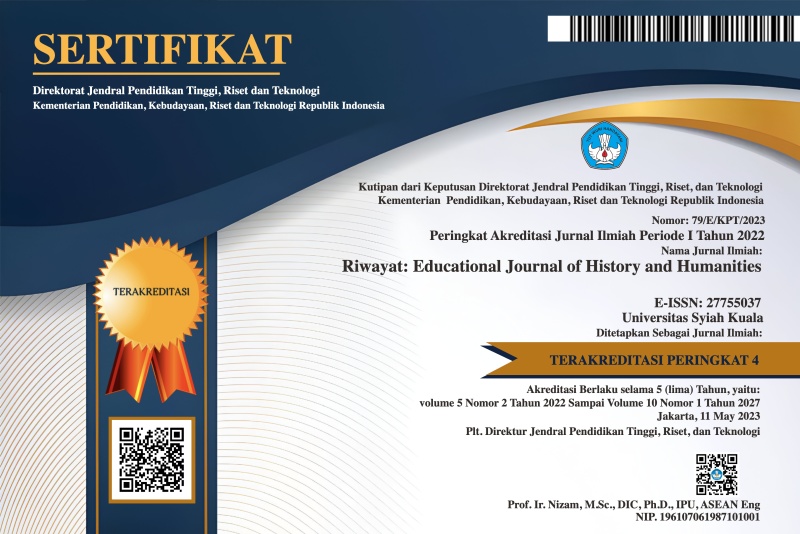
Riwayat: Educational of History and Humanities
E-ISSN 2775-5037
P-ISSN 2614-3917
Published by History Education Department, Faculty of Teacher Training and Education, Universitas Syiah Kuala, Province Aceh. Indonesia
W :https://jurnal.usk.ac.id/riwayat
E : riwayat@usk.ac.id

This work is licensed under a Creative Commons Attribution-ShareAlike 4.0 International License.