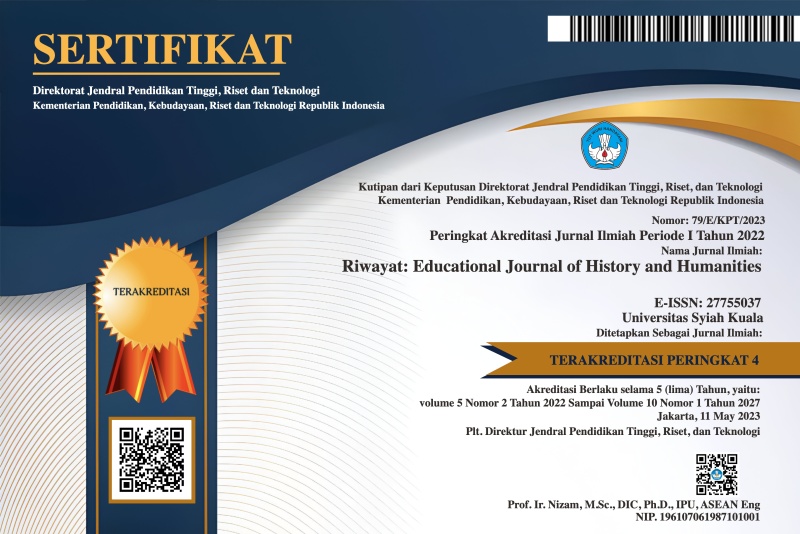
 Riwayat: Educational Journal of History and Humanities











Bentuk Bentuk Tradisi Intelektual Umat Islam dalam Perspektif Sejarah Pendidikan Islam
Abstract
This research aims to examine various forms of Islamic intellectual traditions from the perspective of the history of Islamic education and their role in building Islamic scientific civilization from classical to modern times. Using a qualitative approach through literature study, this research explores primary sources in the form of the works of great scholars such as Al-Ghazali, Ibnu Khaldun, and Al-Farabi, as well as secondary sources in the form of relevant books and scientific journals. The research results show that the Islamic intellectual tradition is not only limited to religious activities, but also includes scientific activities such as rihlah ilmiyah (journey for knowledge), ijtihad, research, reading, writing, memorizing, mensyarah, rawqiq, and building libraries. These traditions show the high scientific ethos of Muslims which makes science a part of worship and a means of building civilization. In the modern context, this tradition remains relevant to be developed as a basis for forming scientific, critical and innovative character in Islamic education
Full Text:
PDFDOI: https://doi.org/10.24815/jr.v8i4.50384
Article Metrics
Abstract view : 0 timesPDF - 0 times
Refbacks
- There are currently no refbacks.
Riwayat: Educational of History and Humanities indexed by
___________________________________________________________
Riwayat: Educational of History and Humanities
E-ISSN 2775-5037
P-ISSN 2614-3917
Published by History Education Department, Faculty of Teacher Training and Education, Universitas Syiah Kuala, Province Aceh. Indonesia
W :https://jurnal.usk.ac.id/riwayat
E : riwayat@usk.ac.id

This work is licensed under a Creative Commons Attribution-ShareAlike 4.0 International License.