Rethinking Community-Based Waste Governance in Informal Urban Settlements

Jenni Ria Rajagukguk

Abstract


Waste management in informal settlement areas in Indonesia is still a complex environmental issue. Limited government services, population density, and minimal infrastructure conditions make waste a major source of pollution and health risks. In the last ten years, the community-based waste governance (CBWG) approach has been widely encouraged by local governments and civil society organizations. However, the effectiveness of this approach varies, depending on local capacity, policy support, and sustainability of citizen participation. This study aims to review the CBWG approach in Indonesia's informal settlements by examining the factors that strengthen or weaken the initiative. The study was conducted in three major cities through a qualitative method that included in-depth interviews with residents, community leaders, NGOs, and environmental officials, as well as participatory observation at the RT/RW level. The results showed that the success of the CBWG was greatly influenced by strong community leadership, economic incentives from recycling activities, and synergy between residents and local government support. On the contrary, fragmentation of responsibilities and lack of long-term planning are the main obstacles. These findings emphasize the importance of building a hybrid governance model that combines local wisdom, institutional support, and social innovation to realize an inclusive, sustainable, and contextual waste management system for informal areas in Indonesia.

Keywords


Community-Based Waste Management; Informal Settlements; Co-Production; Urban Resilience; Environmental Justice

Full Text:

PDF

References


Adelodun, B., Ajibade, F. O., Ighalo, J. O., Odey, G., Ibrahim, R. G., Kareem, K. Y., Bakare, H. O., Tiamiyu, A. O., Ajibade, T. F., & Abdulkadir, T. S. (2021). Assessment of socioeconomic inequality based on virus-contaminated water usage in developing countries: a review. Environmental Research, 192, 110309.

Aparcana, S. (2017). Approaches to formalization of the informal waste sector into municipal solid waste management systems in low-and middle-income countries: Review of barriers and success factors. Waste Management, 61, 593–607.

Bandola-Gill, J., Arthur, M., & Leng, R. I. (2023). What is co-production? Conceptualising and understanding co-production of knowledge and policy across different theoretical perspectives. Evidence & Policy, 19(2), 275–298.

Brotosusilo, A., Utari, D., Negoro, H. A., Firdaus, A., & Velentina, R. A. (2022). Community empowerment of waste management in the urban environment: More attention on waste issues through formal and informal educations. Global Journal of Environmental Science and Management, 8(2), 209–224.

Burgess, R. G., Pole, C. J., Evans, K., & Priestley, C. (2002). Four studies from one or one study from four?: Multi-site case study research. In Analyzing qualitative data (pp. 129–145). Routledge.

Fathurrohman, A., Dayat, M., Ahwan, Z., Abror, M. D., Hakim, L., Apriwiyanto, S. S., Syafi’i, I., Aji, F. R., & Wobisono, M. (2018). Implementasi Manajemen Bank Sampah IT pada Komunitas Bank Sampah berbasis Masyarakat, Pemuda, dan Sekolah di Kabupaten Pasuruan. Engagement: Jurnal Pengabdian Kepada Masyarakat, 2(2), 154–167.

Fox, A., Ziervogel, G., & Scheba, S. (2023). Strengthening community-based adaptation for urban transformation: managing flood risk in informal settlements in Cape Town. Local Environment, 28(7), 837–851.

Furlong, C., Rajapaksha, N. S., Butt, K. R., & Gibson, W. T. (2017). Is composting worm availability the main barrier to large-scale adoption of worm-based organic waste processing technologies? Journal of Cleaner Production, 164, 1026–1033.

Indonesia, P. R. (2017). Peraturan Presiden No. 97 Tahun 2017 tentang Kebijakan dan Strategi Nasional Pengelolaan Sampah Rumah Tangga (SRT) dan Sampah Sejenis Sampah rumah tangga (SSRT). Retrieved December, 2, 2019.

Jenkins, E. K., Slemon, A., Haines-Saah, R. J., & Oliffe, J. (2018). A guide to multisite qualitative analysis. Qualitative Health Research, 28(12), 1969–1977.

KLHK, S. L. H. I., DUGAAN, T. M. I. L. D. A. N., & DISIDANGKAN, B. P. P. T. B. P. P. S. (2020). Kementerian Lingkungan Hidup dan Kehutanan. Republik Indonesia.

Loewenson, R. (n.d.). What have we learned from experience?

Massud, M. E. I., & Aktar, A. (2020). Beneficiary Accountability of NGOs: A Case Study on a Women Empowerment Based Advocacy NGO. The Cost and Management, 48(02), 41–53.

Nurmandi, A. (2022). Manajemen perkotaan. Bumi Aksara.

Ragolane, M., & Khoza, N. G. (2024). The use of hybrid governance and co-production for effective service delivery: A South African local government perspective.

Romero, D., Kwan, A., & Suchman, L. (2019). Methodologic approach to sampling and field-based data collection for a large-scale in-depth interview study: The Social Position and Family Formation (SPAFF) project. PloS One, 14(1), e0210776.

Romulo, C. S., & Dalimunthe, Z. (2024). Effect of related party transaction and tax haven utilization on tax avoidance moderated by Country-by-Country reporting. Riwayat: Educational Journal of History and Humanities, 7(1), 26-40.

Setiawati, I., Wardani, S., & Lestari, W. (2024). Development of Wordwall-based Indonesian Geographical Condition Assessment Instrument in Modipaskogo E-Book for Elementary School Students. Riwayat: Educational Journal of History and Humanities, 7(1), 48-65.

Sholanke, D., & Gutberlet, J. (2022). Call for participatory waste governance: waste management with informal recyclers in Vancouver. Journal of Environmental Policy & Planning, 24(1), 94–108.

Ulum, M. C., & Ngindana, R. (2017). Environmental governance: Isu kebijakan dan tata kelola lingkungan hidup. Universitas Brawijaya Press.

Walker, L. (2009). Community-based water monitoring: Bridging citizens and decision makers. Masters of Arts in Environment and Management. Royal Roads University, Victoria, BC.

Whiteman, A. D., Hennessy, N., & Wilson, D. C. (2025). Rethinking waste and resource management for underserved communities. Oxford Development Studies, 1–17.

Wulandari, D. (2024). The Effectiveness of Youtube Channel as Learning Media at Conversation Class. Riwayat: Educational Journal of History and Humanities, 7(1), 67-69.


DOI: https://doi.org/10.24815/jr.v8i3.47383

Article Metrics

Abstract view : 13 times
PDF - 11 times

Refbacks

  • There are currently no refbacks.


Creative Commons License
This work is licensed under a Creative Commons Attribution 4.0 International License.

__________________________________________________________

Riwayat: Educatioanl Journal of History and Humanities
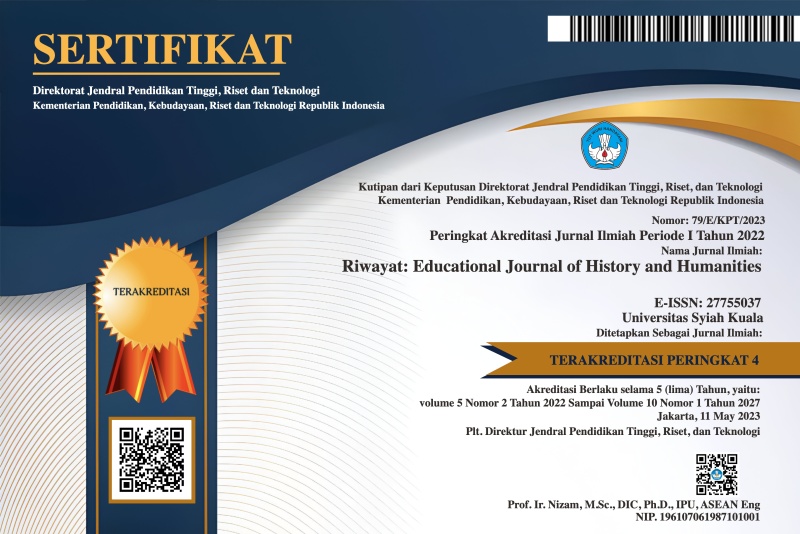

Published: Departemen of History Education, Faculty of Teacher Training and Education, Universitas Syiah Kuala, Provinsi Aceh. Indonesia

Situs web: https://jurnal.usk.ac.id/riwayat
Email: riwayat@usk.ac.id

Lisensi Creative Commons
Karya ini dilisensikan di bawah Lisensi Internasional Creative Commons Atribusi-BerbagiSerupa 4.0.